


Section 179 for Fire Sprinklers in Santa Rosa: Tax Deduction
For Santa Rosa businesses, the Section 179 deduction for fire sprinklers may let a business expense eligible commercial system costs, subject to tax rules and the business’s taxable income. Separately, qualifying commercial sprinkler installations and retrofits properly classified and placed in service after January 19, 2025, may qualify for 100 percent bonus depreciation.
It’s easy to treat these tax provisions as interchangeable, but they’re different routes to recovering eligible costs, and a sprinkler project doesn’t automatically qualify for either one. This guide explains how Section 179 applies to commercial fire sprinkler work, what eligibility and income limits can affect the deduction, and how bonus depreciation differs. You’ll also see why system classification and the date the project is placed in service matter when considering the tax treatment of a Santa Rosa installation or retrofit.
Table of Contents
Eligibility factors for federal tax incentives
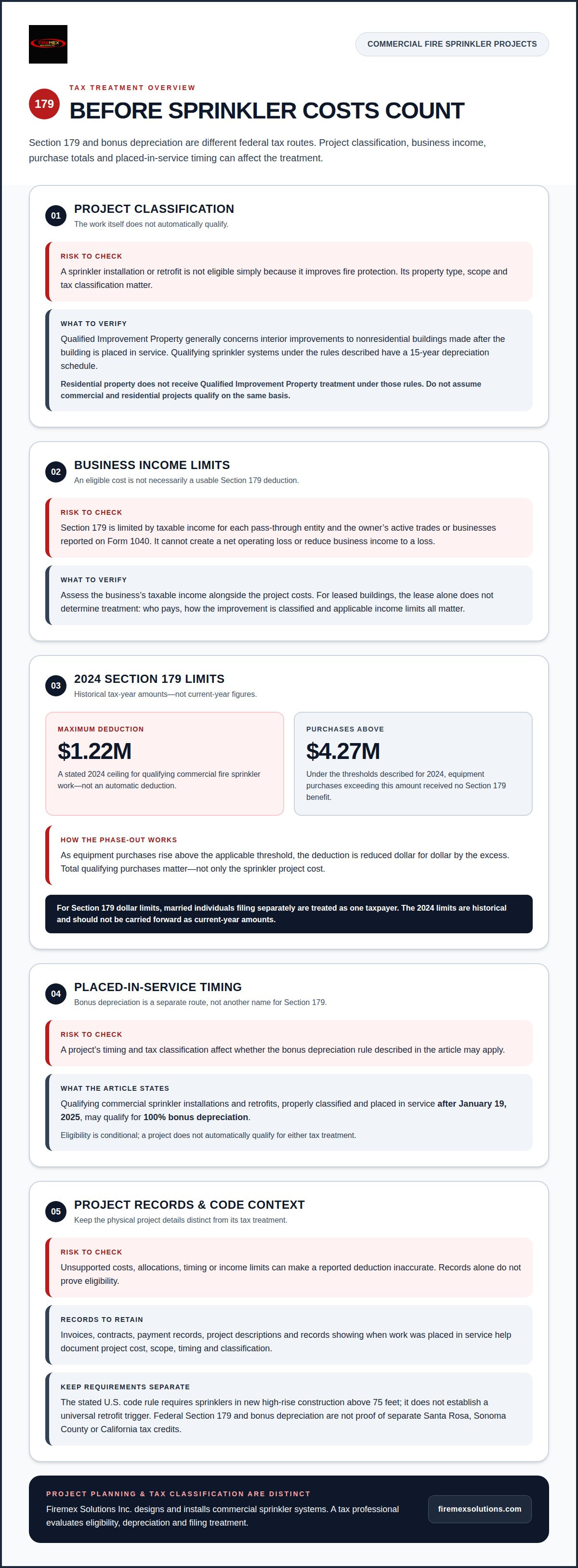
Eligibility depends on the property, the work performed, its tax classification, and the business’s income. The Tax Cuts and Jobs Act, H.R. 1, expanded Section 179 eligibility to certain improvements to nonresidential real property. That expansion doesn’t make every sprinkler project eligible. A commercial installation or retrofit must meet the applicable tax classification rules.
Qualified Improvement Property generally covers interior improvements to nonresidential buildings made after the building is placed in service. Under the rules described for that property, qualifying fire sprinkler systems have a 15-year depreciation schedule. Residential property doesn’t receive Qualified Improvement Property treatment under those rules, so commercial and residential projects shouldn’t be assumed to qualify on the same basis.
Taxable income also matters. Section 179 deductions are limited by the taxable income of each pass-through entity and by the owner’s active trades or businesses reported on Form 1040. A Section 179 deduction can’t create a net operating loss or reduce business income to a loss. Bonus depreciation follows a different rule: qualifying commercial sprinkler installations and retrofits, properly classified and placed in service after January 19, 2025, may be eligible for 100 percent bonus depreciation.
For IRS documentation, keep invoices, contracts, payment records, project descriptions, and records showing when the work was placed in service. These documents help establish the project’s cost, scope, timing, and tax classification. They do not prove eligibility on their own; applicable tax rules and the business’s records determine how the costs are treated on its return.
2024 Section 179 deduction maximum
For the 2024 tax year, the Section 179 deduction for qualifying commercial fire sprinkler work had a stated maximum of $1.22 million. That figure is a ceiling, not an automatic deduction. The business also needed to meet eligibility requirements, and its total qualifying purchases affected the amount it could claim.
The deduction may be reduced as equipment purchases rise above the applicable threshold. Above that threshold, the deduction was reduced dollar for dollar by the excess. For example, once purchases move beyond the phase-out starting point, the available Section 179 amount falls rather than remaining at the full $1.22 million cap.
Under the thresholds described for 2024, a business with equipment purchases exceeding $4.27 million received no Section 179 benefit. That makes the total placed into the calculation important, not just the cost assigned to a sprinkler project. A business near either threshold should distinguish eligible project costs from its broader equipment purchases when assessing the potential deduction.
Filing status also affects the limit. For Section 179 dollar limits, married individuals filing separately are treated as one taxpayer. The 2024 figures are historical tax-year limits, so they shouldn’t be carried forward as current-year amounts. Residential property also requires careful classification: residential property isn’t treated as Qualified Improvement Property under the rules described earlier, and commercial-project assumptions shouldn’t automatically be applied to a residential installation.
Section 179 expensing for commercial fire sprinkler systems
Section 179 can allow a business to expense qualifying commercial fire sprinkler costs instead of recovering them through depreciation over time. The central question is how the work and property are classified for federal tax purposes. A system installation or retrofit isn’t automatically eligible simply because it improves fire protection.
For a nonresidential building, Qualified Improvement Property generally covers interior improvements made after the building is placed in service. Qualifying sprinkler work may receive this treatment, depending on the project’s scope and classification. Improvements that do not meet the relevant criteria may have a different depreciation treatment. Under the rules described, residential property does not qualify as Qualified Improvement Property.
In a leased building, the lease alone does not determine the federal tax treatment. The analysis includes who pays for the project, how the improvement is classified, and whether applicable income limits allow the deduction. These details are especially relevant when a tenant pays for work that becomes part of the building.
Santa Rosa and California code requirements depend on the building and project. The stated U.S. code rule requires sprinklers in new high-rise construction above 75 feet; it doesn’t establish a universal retrofit trigger for every property. Section 179 and bonus depreciation are federal provisions, not proof of separate Santa Rosa, Sonoma County, or California tax credits.
A key filing risk is claiming costs without support for eligibility, allocation, timing, or income limits, which can make a reported deduction inaccurate. Consult a tax professional about leased property, mixed-use buildings, shared project costs, or how the rules apply to the business’s return.
Firemex Solutions Inc.
Firemex Solutions Inc. helps property owners plan fire sprinkler projects around the building’s protection needs and system design. For a commercial installation or retrofit, a clear scope distinguishes the physical work from the tax classification decisions made for a return. Firemex designs and installs commercial sprinkler systems to support a well-defined project plan.
Discuss the building type, project goals, and planned work early. This helps clarify the sprinkler work involved, while a tax professional evaluates eligibility, depreciation, and filing treatment. Firemex Solutions Inc. also designs and installs residential systems and underground fire service as part of property projects.
For help planning a fire sprinkler project, contact Firemex Solutions Inc.
Plan Your Next Sprinkler Project With Confidence
For property owners considering the Section 179 deduction for fire sprinklers in Santa Rosa, the next step is to align the project plan with tax preparation. Keep the system’s scope, project timing, and building use clear in the records shared with your tax professional. That gives them a grounded basis for evaluating the work while keeping life-safety decisions focused on the building’s protection needs.
Firemex Solutions Inc. supports property projects involving residential or commercial sprinkler systems and underground fire service. A clearly defined scope connects the building’s protection needs with the planned work, without treating a tax deduction as a substitute for sound fire protection.
Move forward with a clear plan for your property. Contact Firemex Solutions Inc. today to discuss your fire sprinkler project.
Frequently Asked Questions
Can fire sprinkler systems qualify for the Section 179 deduction?
Yes, certain commercial fire sprinkler installations or improvements may qualify when they meet Section 179’s property and business requirements. For Santa Rosa businesses, the Section 179 deduction for fire sprinklers depends on the system’s classification, the building’s use, eligible project costs, and taxable income. A sprinkler project alone doesn’t establish eligibility; its tax treatment depends on how the improvement fits federal rules.
What Section 179 limits and phase-out thresholds apply for the current tax year?
Section 179 has a tax-year-specific deduction limit and a phase-out based on total qualifying purchases. The 2024 thresholds shouldn’t be assumed to apply to the current tax year. For a current-year calculation, the business’s eligible purchases and applicable annual limits determine the available deduction. The phase-out considers total qualifying purchases, not only the sprinkler project.
Can businesses deduct fire sprinkler installation costs under Section 179, bonus depreciation, or regular depreciation?
Potentially, but these are distinct tax treatments. Section 179 is subject to its deduction and taxable-income limits. Qualifying commercial sprinkler installations and retrofits, properly classified and placed in service after January 19, 2025, may be eligible for 100 percent bonus depreciation. If neither immediate-expensing route applies, regular depreciation may recover eligible costs over the applicable schedule.
Are fire sprinkler upgrades eligible for Section 179 if installed in an existing commercial building?
They may be, particularly when an upgrade is an interior improvement to a nonresidential building already in service and qualifies as Qualified Improvement Property. For example, a retrofit in an operating retail building needs evaluation based on its scope and tax classification. A Section 179 deduction for fire sprinklers in Santa Rosa isn’t automatic just because the property is an existing commercial building.
Comments