


Fire Suppression for Pharmaceutical Manufacturing in Concord
A pharmaceutical facility needs fire suppression matched to the hazards in each area. In Concord, fire suppression for pharmaceutical manufacturing can include sprinkler systems designed around the risks in production spaces, laboratories, clean rooms, and high-value storage.
Protecting equipment and materials matters, but fire suppression for pharmaceutical manufacturing in Concord must also fit the facility’s operations. Systems can be planned around good manufacturing practice requirements, contamination controls, and validation processes. This article explains how sprinkler protection fits pharmaceutical facilities, what changes in manufacturing and clean-room environments, and which project details shape the design. A qualified fire sprinkler contractor can help move a project from design toward installation with safety and operational needs in view.
Table of Contents
Fire sprinkler systems for pharmaceutical manufacturing facilities
Pharmaceutical fire protection starts by matching suppression systems to each area’s hazards and operating conditions. Production rooms, solvent storage, and sensitive equipment may call for different designs.
Detection and Automatic Suppression
Fire detection should connect with automatic suppression and the facility’s emergency response system so alerts and response actions follow a defined path. For each production area, map hazards, detection coverage, sprinkler protection, and system interfaces. Design, installation, commissioning, and maintenance all matter: commissioning checks system operation, while ongoing maintenance supports readiness. In facilities with continuous production schedules, plan system access and coordinate maintenance to reduce operational disruption.
Suppression Options for Production Areas
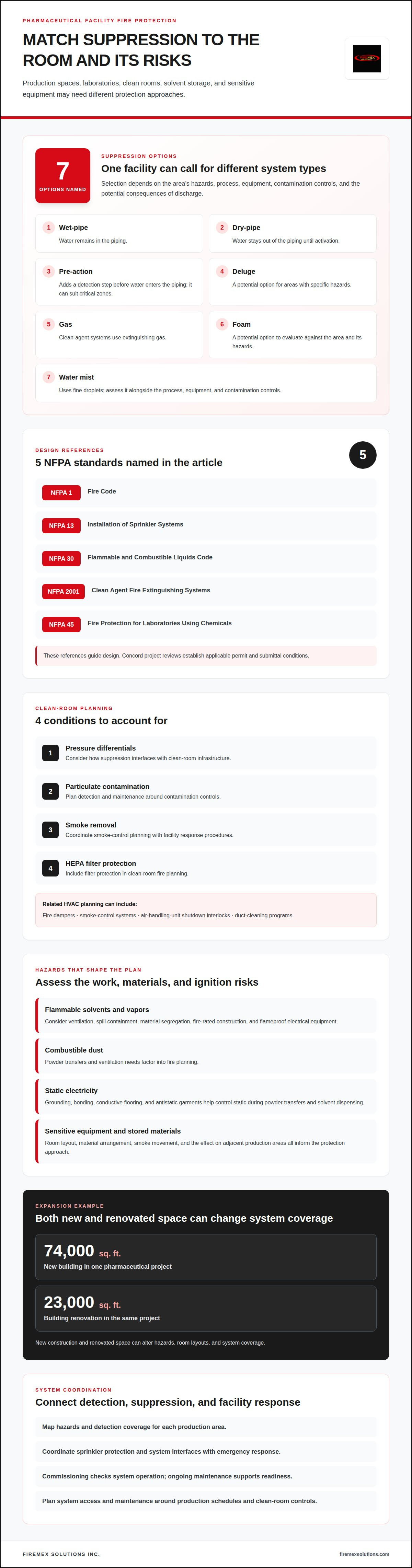
Pharmaceutical facilities may use wet-pipe, dry-pipe, deluge, pre-action, gas, foam, or water-mist systems, selected for the area and its hazards. Wet-pipe systems keep water in the piping; dry-pipe systems keep it out until activation. Pre-action systems add a detection step before water enters the piping, which can suit critical zones. Water mist uses fine droplets, while clean-agent systems use extinguishing gas. Compare options based on the process, equipment, contamination controls, and potential consequences of discharge.
Pharmaceutical fire-protection designs reference NFPA 1, the Fire Code; NFPA 13, the Installation of Sprinkler Systems standard; and NFPA 30, the Flammable and Combustible Liquids Code. Concord project reviews establish applicable permit and submittal conditions. These references guide design, but they should not be confused with a specific local permit determination.
For a Concord project, choose a fire suppression contractor able to coordinate system design, installation, commissioning, and maintenance. The project team should assess production hazards and critical zones, then align fire detection and suppression with facility operations.
Manufacturing facilities, laboratories, clean rooms, and high-value storage
Protection plans should reflect the distinct hazards in production rooms, laboratories, cleanrooms, and warehouses. A professional assessment considers stored chemicals, sensitive equipment, smoke movement, and contamination controls when shaping the protection approach.
Special-Hazard and Clean-Agent Protection
Clean-agent systems can be considered for rooms where residue from a discharge could affect equipment or materials. Pharmaceutical fire-protection designs may reference NFPA 2001, the Clean Agent Fire Extinguishing Systems standard. The right choice depends on the room’s hazard, contents, and operational needs. Design should also account for how suppression interfaces with cleanroom infrastructure and facility response procedures.
Protecting Chemicals, Laboratories, and Equipment
Fire protection professionals assess chemical storage, laboratory activities, and production equipment as distinct hazards. NFPA 45, the Fire Protection for Laboratories Using Chemicals standard, is a relevant reference for laboratory planning. For chemical storage, protection planning also considers room layout, material separation, and how a fire could affect adjacent production areas. In warehouses, stored materials and their arrangement help shape the system design.
Cleanroom protection must address pressure differentials, particulate contamination, smoke removal, and HEPA filter protection. HVAC planning can include fire dampers, smoke-control systems, air-handling-unit shutdown interlocks, and duct-cleaning programs. Detection and maintenance planning should account for cleanroom access and contamination controls, so system checks can be coordinated with facility operations. For ongoing sprinkler upkeep in these environments, fire sprinkler maintenance can support system readiness.
Fire hazards in pharmaceutical, biomedical, and biotechnology facilities
Flammable solvents, airborne dust, and static electricity create distinct fire hazards in pharmaceutical and biotechnology operations. Powder transfers and solvent dispensing can generate static; grounding, bonding, conductive flooring, and antistatic garments help control it. A fire can also interrupt the supply of life-critical treatments, so fire safety is part of protecting sensitive production and laboratory work.
Solvent vapors require attention in storage and process areas. Fire planning considers ventilation, spill containment, material segregation, fire-rated construction, and flameproof electrical equipment. Spark-proof or explosion-resistant motors, switches, lighting, and control panels can address ignition hazards where flammable solvents are handled. Ventilation should dilute vapors and remove airborne dust, and air movement in solvent-use areas needs careful assessment.
Early detection supports a coordinated response in healthcare, biomedical, and laboratory environments. Connect fire detection with the facility’s emergency response system, and include evacuation routes, contacts, assembly areas, firefighting responsibilities, and utility shut-offs in emergency planning. Hot work permits address maintenance tasks such as welding, cutting, grinding, and electrical repairs. Fire drills can help assess evacuation, alarm effectiveness, response speed, and staff communication.
Facility expansion also changes the protection picture. One pharmaceutical project included a new 74,000 sq. ft. building and renovation of a 23,000 sq. ft. building. New construction and renovated space can alter hazards, room layouts, and system coverage, so fire protection planning should account for both. For project-specific sprinkler planning, discuss fire sprinkler system design as part of the facility’s expansion and fire-safety work.
Firemex Solutions Inc.
Firemex Solutions Inc. helps property owners plan commercial fire sprinkler protection around facility layouts and project needs. For pharmaceutical manufacturing in Concord, its fire sprinkler system design service can support planning for production, laboratory, and storage areas, while commercial fire sprinkler systems address building-wide protection. When a project includes fire-service infrastructure, Underground Fire Service can also be part of the broader system scope.
Turn to Firemex Solutions Inc. when planning a new facility, expanding an existing site, or reviewing how sprinkler protection fits your operations. Its installations meet current state codes and national safety standards.
Plan the next step for your facility
Use the planning process to connect fire protection decisions with your facility’s future needs. A new production line, renovation, or change in stored materials can affect how a system fits the building and its operations. A clear project scope helps identify design decisions that need attention before work begins.
Firemex Solutions Inc. provides residential and commercial fire sprinkler systems, as well as Underground Fire Service. For pharmaceutical operations, the relevant next step is discussing how commercial sprinkler planning can align with the facility’s layout and project requirements. A fire suppression plan for pharmaceutical manufacturing in Concord should support the site’s operational priorities while addressing its specific hazards.
Contact Firemex Solutions Inc. to discuss your facility’s fire sprinkler needs and move forward with a clear plan.
Frequently Asked Questions
What are the NFPA requirements for fire protection in pharmaceutical manufacturing?
Pharmaceutical fire-protection designs reference several NFPA standards, depending on the hazard and system. NFPA 1 is the Fire Code; NFPA 13 addresses sprinkler-system installation; NFPA 30 covers flammable and combustible liquids; NFPA 45 applies to chemical laboratories; and NFPA 2001 covers clean-agent systems. These references inform design, while Concord project reviews establish applicable local permit conditions.
What fire suppression systems are appropriate for pharmaceutical cleanrooms and sensitive equipment?
Suitable options depend on the room’s hazards, contents, and tolerance for discharge effects. A clean-agent system may suit sensitive equipment where residue is a concern, while a sprinkler system may fit other spaces. NFPA 2001 is a relevant reference for clean-agent design. Project planning should also consider room use, contamination controls, and how suppression interacts with facility operations.
What are the costs of installing and maintaining fire suppression systems in a pharmaceutical facility?
Installation and maintenance costs depend on facility size and layout, hazard classification, system choice, water supply, and project scope. Firemex Solutions Inc. offers free estimates; pricing follows a quote request. For facilities in Concord, San Francisco, San Jose, Oakland, Redwood City, Los Altos, Hayward, Fremont, Burlingame, Belmont, San Mateo, San Carlos, Palo Alto, Cupertino, Berkeley, Santa Rosa, Saratoga, and Mountain View, existing infrastructure also shapes the project scope.
How often must pharmaceutical fire suppression systems be inspected, tested, and maintained?
Inspection, testing, and maintenance intervals depend on the installed system, its components, and applicable requirements. A facility plan should identify covered equipment and areas, document completed work, and account for changes to production spaces or system layouts. Fire sprinkler maintenance helps keep system components in working condition; the schedule should reflect the facility’s equipment and operating conditions.
What fire hazards are common in pharmaceutical manufacturing, including flammable solvents and combustible dust?
Common concerns include flammable solvent vapors, combustible dust, and static electricity during powder transfers or solvent dispensing. Electrical equipment can also become an ignition source where flammable materials are handled. Hazard reviews should consider where materials are used and stored, ventilation, ignition sources, and how process or facility changes could alter exposure. These factors help shape practical fire-safety planning.
Comments