


Fire Protection in San Francisco & the Bay Area: The 2026 Property Owner’s Buying Guide
How much will a single failed SFFD inspection cost your business in 2026 when you factor in project delays and potential legal penalties? For property owners across San Francisco, the gap between "good enough" and full compliance is a financial risk that could stall a development for months. You already know that managing fire protection in a city with some of the strictest safety standards in the nation is a heavy responsibility. It's about more than just hardware; it's about the peace of mind that comes from knowing your investment is secure and your occupants are safe.
This guide gives you the tools to navigate the 2026 California Fire Codes with 100% confidence. You'll learn how to select the right suppression systems for your specific building type and how to partner with a C-16 contractor who understands the nuances of local SJFD and SFFD requirements. We'll explore the design-build process, essential retrofitting for older structures, and how professional oversight helps you achieve A+ service while Protecting What MatterS Most! We're Always Ready to help you move from compliance stress to total safety leadership.
Key Takeaways
Distinguish between active and passive fire protection systems to ensure your building is shielded from every angle.
Match your suppression strategy to your specific occupancy group, whether you're managing a single-family ADU or a large commercial space.
Evaluate the advantages of a "Design-Build" approach to streamline communication and reduce the risk of non-compliance during installation.
Learn how precise hydraulic calculations and expert design prevent water pressure issues and ensure your system passes SFFD standards the first time.
Secure the peace of mind that comes from full 2026 code compliance while Protecting What MatterS Most!
Table of Contents Understanding Active and Passive Fire Protection in the Bay Area Buying Guide: Selecting the Best Fire Protection System for Your Property Implementing Your Safety Strategy: Design, Installation, and Maintenance
Understanding Active and Passive Fire Protection in the Bay Area
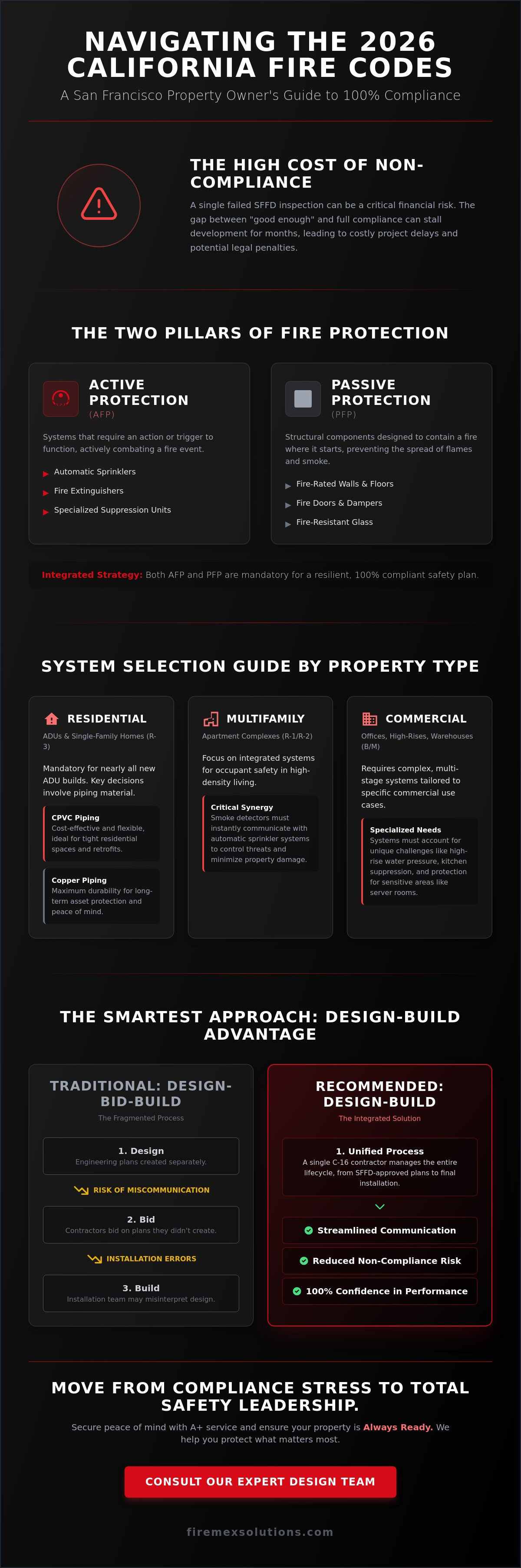
Effective fire protection is the integrated strategy of detection, containment, and suppression to ensure life safety for every occupant in a building. In the dense urban environments of Oakland and San Jose, where structures are often separated by only a few feet, a balanced safety plan isn't just a recommendation; it's a mandatory requirement for 2026 compliance. This strategy relies on two distinct but complementary pillars: Active Fire Protection (AFP) and Passive Fire Protection (PFP).
Active Fire Protection (AFP) includes systems that require a specific action or trigger to function. This category encompasses your automatic sprinklers, fire extinguishers, and specialized suppression units. Conversely, Passive Fire Protection (PFP) consists of structural components designed to contain a fire where it starts. These fire-rated walls, floors, and smoke dampers don't "do" anything during an event except exist as a barrier to prevent the spread of flames and toxic gases. You need both to achieve 100% confidence in your building's resilience.
The Role of SFFD and NFPA 25 in Local Compliance
The San Francisco Fire Department (SFFD) maintains strict authority over all local building permits and safety certifications. To pass their rigorous inspections, property owners must adhere to NFPA 25, which serves as the California "gold standard" for the inspection, testing, and maintenance of water-based fire protection systems. Missing a single quarterly inspection can lead to costly citations and increased liability. We ensure your records are always up to date and your systems are Always Ready.
Why Modern SF Properties Require Integrated Systems
Modern developments in the Bay Area demand that fire protection and safety are baked into the initial design-build phase. In multi-unit residential buildings, the synergy between smoke detection and automatic sprinkler activation is vital. When sensors detect a threat, they must instantly communicate with the suppression system to control the heat. This integrated approach minimizes property damage and provides the highest level of security while Protecting What MatterS Most!
Buying Guide: Selecting the Best Fire Protection System for Your Property
Choosing the right fire protection system depends entirely on your specific occupancy group and building type. Whether you're managing a Residential (R-3) single-family home, a Multifamily (R-1/R-2) apartment complex, or a Commercial (Group B/M) office space, the 2026 codes dictate unique hardware and flow requirements. Identifying these needs early prevents the high cost of mid-project redesigns and ensures your property is Always Ready for its final inspection.
For most Bay Area projects, the Design-Build procurement model offers the most reliable path to compliance. Unlike the traditional Design-Bid-Build approach, which separates engineering from installation, Design-Build allows a single C-16 contractor to manage the entire lifecycle. This creates a firm handshake between the initial SFFD-approved plans and the physical installation, giving you 100% confidence that the system will perform exactly as intended. If you need clarity on your project's scope, you can consult with our expert design team for a professional assessment.
Aesthetics and infrastructure also play a significant role in your selection. In high-end markets like Los Altos and Saratoga, owners often prefer concealed sprinkler heads that sit flush with the ceiling to preserve the home's interior design. Meanwhile, new Palo Alto developments must prioritize underground fire service installations. These systems require precise planning to ensure the water supply meets the hydraulic demands of the building while satisfying local fire marshal standards for 2026.
Residential Sprinklers for ADUs and Single-Family Homes
California mandates for 2026 require residential fire sprinkler systems in nearly all new Accessory Dwelling Unit (ADU) builds. When planning a retrofit, you must weigh the benefits of CPVC versus copper piping. CPVC is a cost-effective, flexible choice for tight residential spaces, while copper provides maximum durability for long-term asset protection. We provide A+ service to help you choose the material that fits your budget and safety goals.
Commercial Fire Suppression: Kitchens, High-Rises, and Warehouses
The requirements for commercial fire protection in San Francisco restaurants and high-rises involve complex, multi-stage systems. For windowless server rooms or data centers in Silicon Valley, water-based sprinklers aren't enough. These spaces require specialized clean agent suppression systems that extinguish flames without damaging sensitive electronics, effectively Protecting What MatterS Most!
Implementing Your Safety Strategy: Design, Installation, and Maintenance
The foundation of any robust safety system begins with precise engineering. Professional hydraulic calculations are the heartbeat of fire sprinkler system design, ensuring that water pressure remains adequate for the specific hazard level of your building. Without these data-driven insights, a system might fail exactly when it's needed most. In cities like San Mateo and Redwood City, a typical retrofit installation often spans four to eight weeks, depending on the complexity of the structure and the speed of local permit approvals. Staying compliant with California law requires more than just installation; you must maintain 5-year and annual certifications to avoid heavy fines. A "Reliable Guardian" contractor manages everything from underground service to final SFFD sign-off, providing you with a seamless path to safety.
The Design-Build Advantage for SF Retrofits
Choosing a single fire protection company near me to handle both engineering and installation significantly reduces project delays. In commercial hubs like Berkeley and Fremont, tenant improvements require intense coordination between multiple trades. When one team manages the design and the physical work, communication gaps disappear. This unified approach ensures that every pipe and head meets the exact specifications of the approved plans, resulting in A+ service and 100% confidence during the final walkthrough.
Ensuring Long-Term Reliability Through Certified Inspections
Passing a fire sprinkler inspection is about maintaining the integrity of your life-safety systems year-round. During an inspection, technicians test alarms, check gauges, and verify that all valves are in their proper positions. To prepare your building, ensure that all fire protection equipment is accessible and that your previous maintenance records are organized for review. Our "Always Ready..." philosophy means we prioritize emergency repairs and routine maintenance across the entire Bay Area, always Protecting What MatterS Most!
Securing Your Bay Area Investment for 2026 and Beyond
You now have a clear roadmap for navigating the complexities of upcoming safety requirements. From choosing between CPVC and copper to understanding the nuances of SFFD inspections, your role as a property owner is to ensure that your building's fire protection remains uncompromising. A balanced strategy that combines active suppression with passive structural barriers is the only way to meet modern standards in San Francisco and the wider Bay Area. Maintaining your 5-year certifications and annual inspections is not just a legal hurdle; it is the most effective way to safeguard your assets and the lives within them.
Don't leave your compliance to chance when the stakes are this high. As a licensed C-16 Fire Protection Contractor with over 20 years of experience in the local market, Firemex Solutions Inc. is your partner in achieving A+ service for both residential and commercial projects. We handle the technical heavy lifting so you can focus on your business with 100% confidence. Our team is Always Ready to help you Protect What MatterS Most with Firemex Solutions Inc. today! We look forward to building a safer, more resilient future for your property.
Frequently Asked Questions
Is fire protection mandatory for residential homes in San Francisco?
Yes, fire protection via automatic sprinklers is mandatory for all new one- and two-family dwellings under California Building Code Section 903.2.8. In San Francisco, SFFD enforcement extends this requirement to new ADUs and residential additions that exceed specific square footage thresholds. If you're performing a major remodel involving over 50% of the existing structure, you'll likely need to upgrade to modern standards to ensure your home is legally compliant and safe.
What is the difference between fire prevention and fire protection?
Fire prevention involves proactive measures to stop a fire from igniting, while fire protection refers to the systems that respond once a fire starts. Prevention includes activities like clearing flammable debris or enforcing smoking bans. Protection focuses on active and passive systems like sprinklers, alarms, and fire-rated barriers. Both are essential for a comprehensive safety plan that offers A+ service and the peace of mind you deserve.
How often does a commercial fire sprinkler system need to be inspected in California?
California Title 19 requires commercial fire sprinkler systems to undergo quarterly, annual, and five-year inspections. Quarterly checks are primarily visual, while the annual inspection involves a physical test of all alarms and water flow. Every five years, a C-16 contractor must perform a rigorous internal pipe inspection to check for obstructions. Keeping these records updated ensures your building remains Always Ready for any official SFFD or SJFD audit.
Can I retrofit an older building in Oakland with a modern sprinkler system?
Yes, retrofitting older buildings in Oakland is entirely possible and often necessary for modern tenant improvements. Using flexible CPVC piping or strategically placed copper lines allows for a seamless installation even in historical structures. A professional design-build approach ensures the new system integrates with the existing architecture without compromising safety. This upgrade provides 100% confidence that you are Protecting What MatterS Most! in your older property.
Comments